
The intersection of cybersecurity and artificial intelligence (AI) is reshaping organizational priorities. Between data protection, AI system management, and the pursuit of long-term digital resilience, harnessing the potential of AI requires that executives also anticipate unprecedented threats.
This morning, some executives have discovered that an apparently legitimate email has deceived their teams. Others have experienced a deepfake mimicking their voice, while a third-party service provider has unknowingly created a critical security breach. Once confined to science fiction, these scenarios now illustrate the emerging AI-related threats that are redefining cybersecurity today.
AI is now both a risk factor to be managed and a strategic, proactive defense tool.
Drawing on our field experience in cybersecurity, we take a closer look at emerging AI-driven threats and explore how AI can become a true lever for resilience when used strategically.
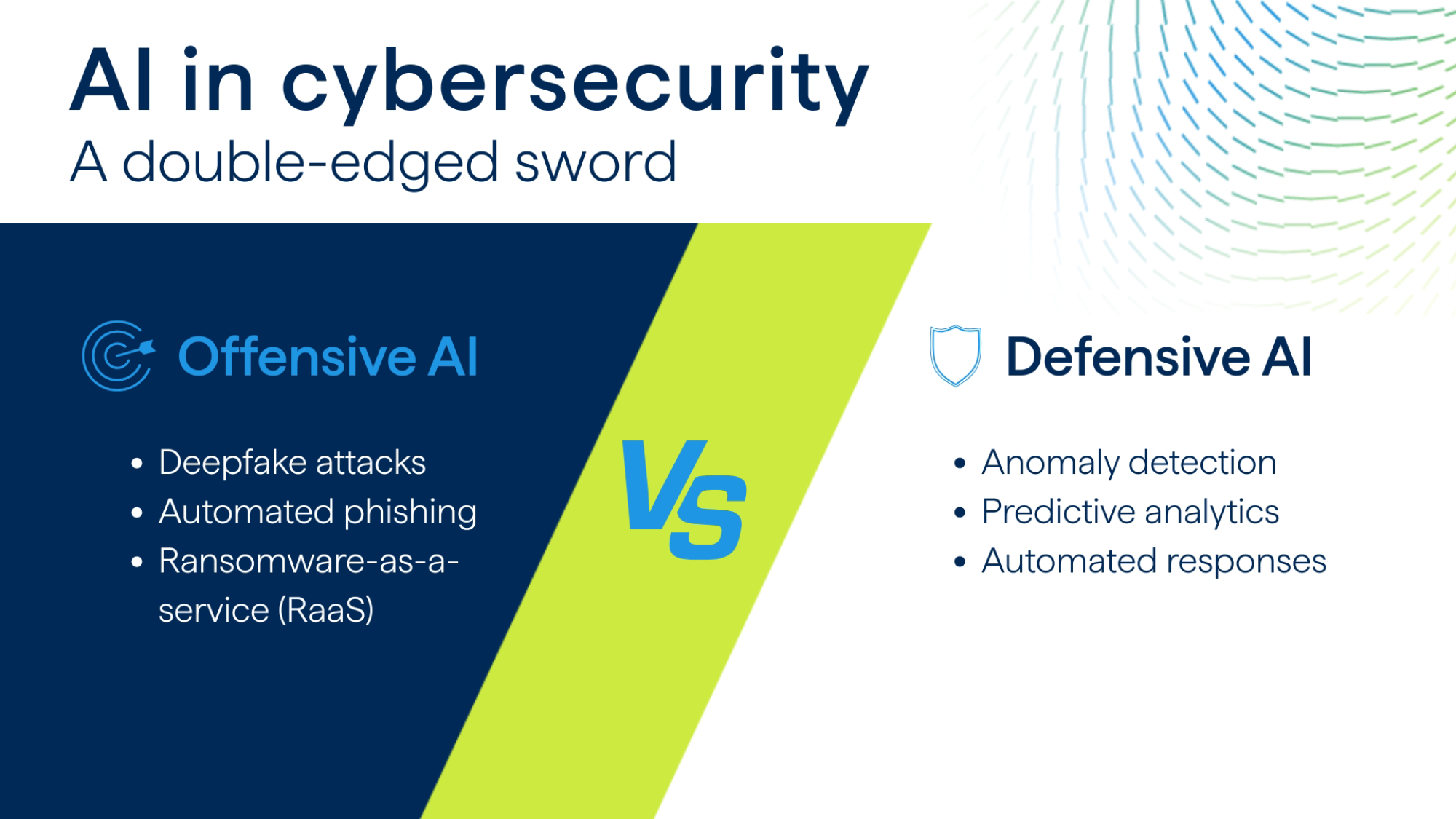
Cybersecurity and AI: a double-edged sword
Whether as a tool used by cybercriminals or a tool to strengthen cyber defense, AI is now a top priority for executives.
On the offensive side: AI as a threat accelerator
AI drives increasingly sophisticated attacks. Phishing campaigns that are indistinguishable from legitimate emails, convincing deepfake videos directly targeting senior executives, and ready-to-use ransomware services enable malicious actors to operate at scale.
Europol has already warned that these tools are “turbocharging” organized cybercrime. Forrester also notes that AI is industrializing such attacks, transforming them from isolated attempts to large-scale, automated campaigns.
On the defensive side: AI as a lever for resilience
The same AI capabilities can also transform cybersecurity by bolstering detection and prevention. Through real-time analysis of billions of signals, AI systems can identify anomalies that would be impossible for human teams to detect. They anticipate attacks, continuously adapt monitoring, and provide executives with a strategic lever for proactive cybersecurity focused on digital resilience.
For organizations, the key lies in governance. AI must be managed, evaluated, and integrated into consistent security frameworks. Gartner emphasizes that trust, risk, and security must be considered together through approaches like AI TRiSM (AI trust, risk and security management).
But for these defensive capabilities to deliver on their promises, they must be built on solid governance and clear organizational practices.
Emerging AI-driven threats
AI doesn’t just create new opportunities, it also reshapes the very nature of attacks. Cybercriminals are already exploiting its capabilities to launch more convincing attacks that are harder to detect.
Recent data confirm this trend. According to TechRadar Pro, a study by the Ponemon Institute shows that deepfake attacks targeting executives are on the rise:
- 41% of surveyed security professionals reported encountering a deepfake attack in 2025, compared to 34% in 2023.
- 54% consider deepfake videos to be one of the main AI-related threats.
- 66% believe a similar incident is likely to occur in the future.
These findings reinforce the need to integrate AI systems into a digital resilience strategy.
Here’s what these threats look like in practice:
- Deepfakes: In seconds, an executive’s voice or image can be mimicked to manipulate an employee into harmful actions.
- Automated phishing campaigns: AI-generated emails, indistinguishable from legitimate messages, are used to map organizational hierarchies and identify key individuals to target as a precursor to deploying ransomware-as-a-service (RaaS).
- AI supply chain: Integrating software connectors, third-party models, or open-source components introduces new vulnerabilities.
- Attacks on AI models (adversarial AI): These attacks target AI models, manipulating or poisoning data to compromise their reliability.
These threats already get past traditional defenses. Addressing them requires rethinking how we approach security.
Why traditional defenses fail against emerging AI threats
For a long time, cybersecurity relied on well-defined barriers: firewalls, antivirus software, and static detection rules. These approaches worked in an environment where threats evolved slowly and attackers needed significant technical expertise. Against emerging AI-driven threats, this model is outdated.
Security must shift towards identity-centric approaches: protecting access, continuously authenticating users, and monitoring behavior to strengthen organizational resilience. Automated phishing emails perfectly mimic an organization’s tone. Deepfakes bypass visual or voice identity checks. Ransomware-as-a-service makes tools once reserved for highly specialized groups widely accessible.
The result: attacks are faster and harder to detect, undermining data protection.
Zero trust and adaptive security
With remote work, cloud computing, and third-party service providers, corporate boundaries are blurring. Executives must adopt a zero-trust approach, where every user, access, and transaction is continuously verified.
This approach helps limit damage. A compromised workstation only provides access to the resources authorized to its user, even if an attacker attempts lateral movement.
The zero-trust model is based on 3 simple but strict principles:
- Never trust by default.
- Always verify access.
- Use least-privileged access.
This model is complemented by adaptive monitoring, where controls evolve in response to observed behaviors.
By adopting this approach, organizations can stay one step ahead of constantly evolving threats and prepare to integrate AI as a defensive tool.
AI as a tool for cyber defense
When properly integrated, artificial intelligence turns cybersecurity into a proactive protection tool.
Anomaly detection and proactive monitoring
Artificial intelligence excels at analyzing massive volumes of data. It identifies weak signals (signals that would be impossible to detect manually) in real time.
A detection model can:
- Identify unusual logins
- Detect suspicious transfers
- Flag connections to malicious sites
- Report unauthorized changes
These alerts enable organizations to respond quickly. They reduce detection times, limit the scope of incidents, and reinforce business continuity. By integrating this type of proactive monitoring, executives can act before an attack occurs, rather than after the fact.
Predictive analytics and real-time response
With machine learning, artificial intelligence does more than detect incidents. It anticipates attacks by assessing their likelihood based on observed behaviors.
These predictive capabilities help organizations:
- Minimize downtime by anticipating disruptions
- Automate rapid responses to limit impact
- Provide executives with a clear view for timely decision-making
Companies gain numerous advantages by incorporating these analyses into their strategy. Analytics transform cybersecurity into a decision support tool and a lever for sustainable performance.
Governance and the AI TRiSM framework
Without clear governance, AI in cybersecurity can be a source of vulnerability. Gartner's AI TRiSM framework provides executives with a method for balancing innovation and security.
The AI TRiSM model helps executives focus on 3 key components:
- Ensuring the transparency of AI models
- Managing data- and bias-related risks
- Protecting systems against misuse and malicious applications
When organizations adopt such a framework, they turn AI into a digital trust tool. It also helps them anticipate future regulations, strengthen compliance, and bolster resilience against emerging threats.
Governance and organizational culture: the human factor in resilience
Even the most advanced technologies lose their effectiveness without solid governance and the right organizational culture. Cyber resilience depends as much on people and processes as on deployed tools.
Governance as a strategic lever
Cybersecurity governance is no longer limited to internal policies. It must now address AI-related risks: data quality, model security, and transparency in automated decision-making. Frameworks like Gartner’s AI TRiSM help align technology risk management with an organization’s strategic objectives. Yet, as MIT Sloan Management Review notes, most organizations have yet to align their risk management practices with the pace of AI-related change.
For executives, this means strengthening board oversight, engaging key stakeholders, and integrating cybersecurity into investment decisions.
Awareness and organizational culture
Cybercriminals exploit the human factor. Credible phishing emails, deepfakes, and automated phone calls target employees directly. Technology alone is not enough to counter these threats.
A culture of vigilance is essential. This is created through regular training, realistic attack simulations, and clear communication with teams. Employees must understand that they are a critical link in resilience, in the same way as cybersecurity tools.
Aligning security and performance
Effective governance connects cybersecurity to business objectives. Outcome-driven metrics demonstrate the value of cybersecurity to the organization.
By enhancing digital trust, minimizing downtime, and ensuring regulatory compliance, cybersecurity becomes a strategic investment rather than an expense.
Priority security actions for executives
With the rise of AI, cybersecurity has become a matter of organizational resilience and digital trust. Executives can act right away on several levers to prepare their organizations for emerging threats.
1. Assess exposure to AI-related threats
Mapping critical systems, entry points, and technology dependencies helps measure real risks. This includes those of third-party service providers and AI models already in use.
2. Integrate AI into defense capabilities
Investing in tools that detect anomalies, predict attacks, and automate responses improves protection speed and effectiveness.
3. Establish robust governance
Adopting frameworks like AI TRiSM governs AI use, limits risks, and ensures transparency. Governance must extend to the highest levels, including the board of directors.
4. Foster a culture of vigilance
Regular employee training, realistic attack simulations, and the promotion of responsible behaviors are key to reducing human vulnerability.
5. Tie cybersecurity to organizational performance
It's important to measure the strategic value of cybersecurity using results-oriented metrics:
- Business continuity
- Digital trust
- Regulatory compliance
Establishing sustainable digital resilience
AI is transforming the cybersecurity landscape at an unprecedented speed. While it creates new threats, it also enables more adaptive defenses.
The key for organizations is to anticipate these changes rather than react as they happen. Those who integrate AI into their governance, strengthen human vigilance, and tie security to performance will transform their cybersecurity from a constraint into a lever of resilience and digital trust.
For further insights, watch our webinar: 5 Steps to Build a Resilient OT/ICS Cybersecurity Program.
Want to learn more about how Alithya supports organizations facing these risks? Discover our cybersecurity and strategic consulting services. To strengthen your cyber strategy, contact our experts.